Tell us about the job
Takes about a minute. No obligation.
Gas-fired water heaters run their burners and igniters every time the tank temperature drops, which happens repeatedly across every day of the year. Utility gas heats more occupied homes in Beaver County, Utah than any other fuel, at 60.4% (2020-2024 ACS 5-year). A contractor diagnosing a failing unit here goes straight to the burner orifice, the thermocouple, and the gas valve, because those parts cycle constantly and wear in ways that a visual inspection of the tank exterior will not catch. Sediment buildup in the tank follows the same logic: hard water and daily demand accelerate it, and a sluggish burner working against scale uses more gas and fails sooner.
Plumbing in housing this old was laid out around equipment that no longer exists, and what replaced it over the decades was not always matched to what the house already had. Half the homes in Beaver County, Utah were built in 1976 or earlier (2020-2024 ACS 5-year). A contractor opening a water heater in stock like this finds anode rods worn past the point of protecting the tank, sediment loads that reduce heating efficiency, and fittings that have been patched more than once. Those findings change the repair scope: a part swap that looks straightforward on a newer unit can turn into a broader job once the tank is drained and the condition of the connections is visible.
The Parts of a Water Heater a Contractor Checks During Repair
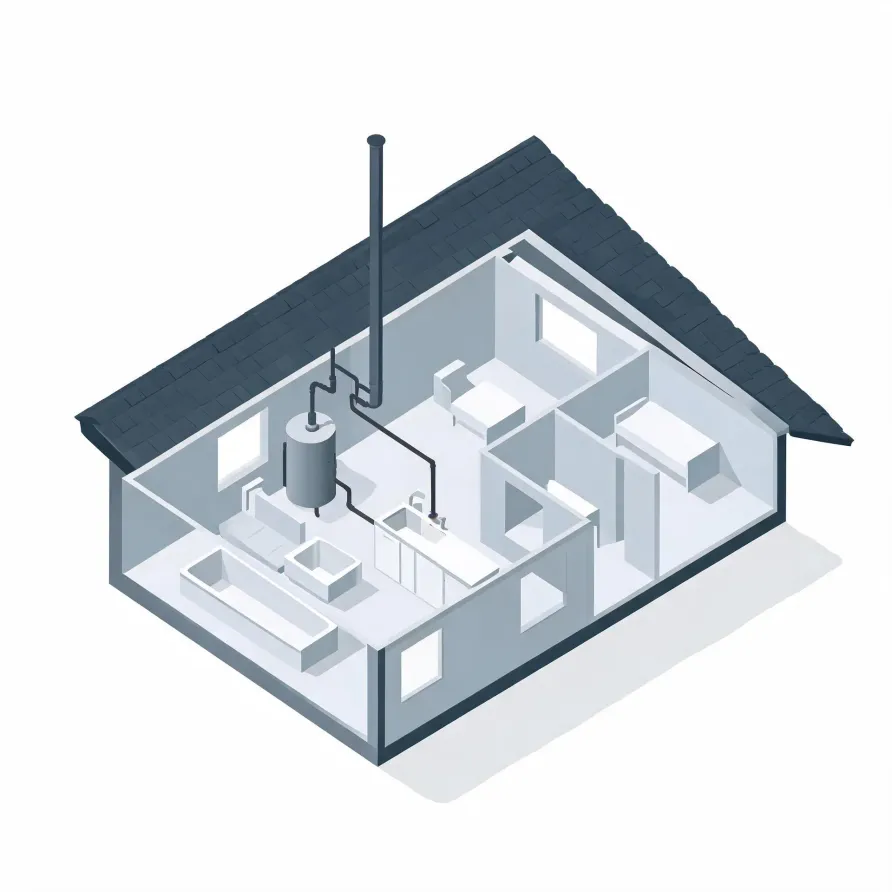
The tank is what most homeowners notice first, a large insulated cylinder that sits in a utility room, basement, or garage and holds water at a set temperature. At its top and bottom are connections where cold water enters and hot water leaves. When the tank itself is the problem, a contractor will look for corrosion, leaks at the seams, or sediment buildup along the floor of the vessel.
The heating element or burner assembly sits inside or beneath the tank depending on whether the unit runs on electricity or gas, and it is what actually raises the water temperature. Alongside it sits the thermostat, which tells the heater when to fire, and the pressure relief valve, mounted on the side of the tank, which opens if pressure inside climbs beyond a safe level. The anode rod runs down through the interior and slows corrosion of the tank walls.
The drawing shows a general layout of a water heater and its components, and a licensed contractor determines what applies to the specific unit and installation in your home.
Get matched in Beaver CountyBeaver County, Utah, by the numbers
88 severe weather events were recorded in Beaver County, Utah between 2015 and 2024.
NOAA National Centers for Environmental Information, Storm Events Database, bulk CSV export, events 2015-01-01 through 2024-12-31.Half the homes in Beaver County, Utah were built in 1976 or earlier (2020-2024 ACS 5-year).
U.S. Census Bureau, 2020-2024 American Community Survey 5-Year EstimatesBeaver County, Utah holds 2,969 housing units (2020-2024 ACS 5-year).
U.S. Census Bureau, 2020-2024 American Community Survey 5-Year EstimatesOwners occupy 81.0% of the occupied homes in Beaver County, Utah (2020-2024 ACS 5-year).
U.S. Census Bureau, 2020-2024 American Community Survey 5-Year EstimatesCodes & Standards Governing Water Heater Repair in Beaver County, Utah2 sourced rules and standards
Licensing and Legal Requirements in Beaver County, Utah
Utah’s contractor licence does not reach alteration, repair, remodelling or improvement of a building worth less than $7,000 in labour and materials together, counting every change and addition to the agreed work — though the plumbing and electrical trades are pulled back under licensure even below that figure.
Utah requires a state licence before engaging in a licensed construction trade or contracting activity, and HVAC contractor is one of the licence classifications the state issues.
Severe Weather Events in Beaver County
Extreme weather puts a strain on water heaters that ordinary use does not. How hard local conditions push that equipment shapes what repair work looks like here.
88 severe weather events, 2015–2024. Source: NOAA National Centers for Environmental Information, Storm Events Database.