Tell us about the job
Takes about a minute. No obligation.
Gas water heaters have a short list of parts that wear in a predictable order: the burner, the thermocouple, the gas valve, and the flue. Utility gas heats more occupied homes in Iron County, Utah than any other fuel, at 66.4% (2020-2024 ACS 5-year). When a contractor opens a failed unit here, the burner assembly and venting path show the accumulated wear that comes from years of combustion cycles. A corroded flue or a thermocouple that has drifted out of range accounts for a large share of the no-heat calls in this area, and a contractor who skips the venting inspection before quoting a repair is leaving the most common cause unexamined.
Water heaters in a house this old have usually been replaced at least once, and what a contractor finds when they open the system tells them more than the install date on the side of the tank. Half the homes in Iron County, Utah were built in 1997 or earlier (2020-2024 ACS 5-year). Sediment load, anode condition, and the state of the pressure relief valve are what determine whether the repair is an hour's work or the start of a longer conversation about the unit. A contractor working on stock from that era cannot quote from the outside.
The Parts of a Water Heater a Contractor Checks During a Repair
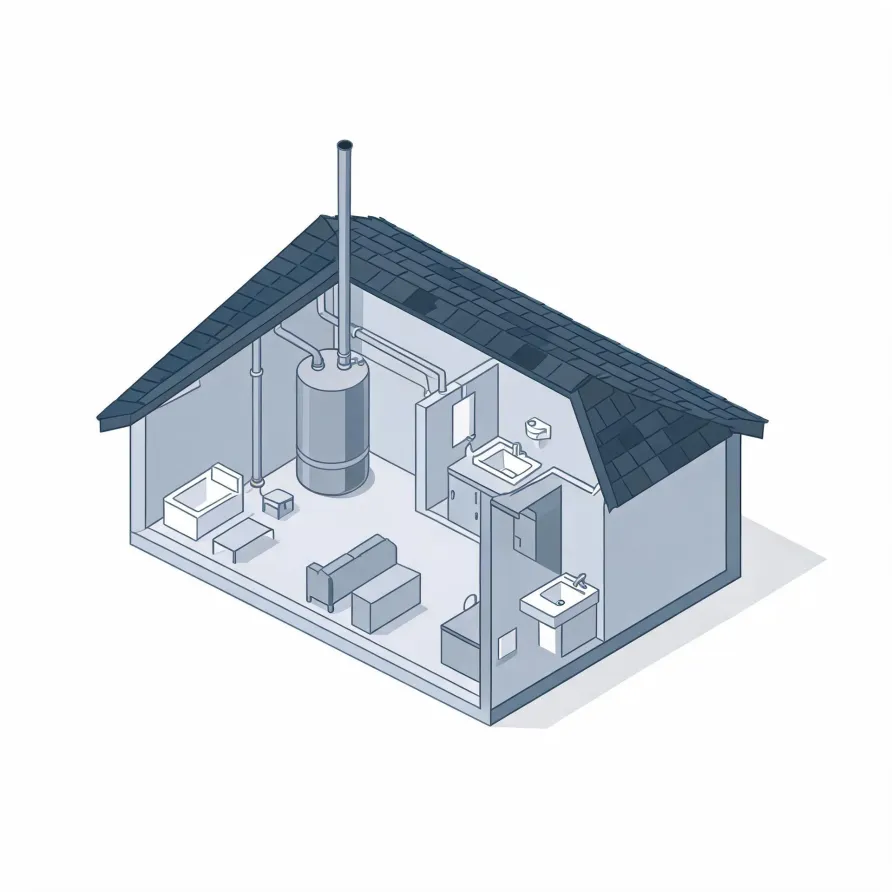
The tank is what most homeowners see: a large insulated cylinder that sits in a utility closet, basement, or garage and holds a standing supply of hot water. On a gas unit, a burner assembly at the base heats the water. On an electric unit, one or two heating elements mounted inside the tank do that job. Either way, a thermostat attached to the tank reads the water temperature and signals the heat source to cycle on or off. When the water runs cold, or the tank makes noise, or it leaks, those are the first pieces a contractor examines.
A pressure relief valve mounts on the side of the tank and opens automatically if internal pressure climbs too high. The anode rod hangs inside the tank and slows corrosion of the tank walls. Cold water enters through a dip tube that runs down to the bottom of the tank, and hot water exits from a port near the top. On gas units, a flue runs from the burner up through the top of the tank and out of the house to carry combustion gases away.
The drawing shows the general layout of a water heater system, and a licensed contractor will determine which parts apply to the specific unit and installation in your home.
Get matched in Iron CountyIron County, Utah, by the numbers
77 severe weather events were recorded in Iron County, Utah between 2015 and 2024.
NOAA National Centers for Environmental Information, Storm Events Database, bulk CSV export, events 2015-01-01 through 2024-12-31.Half the homes in Iron County, Utah were built in 1997 or earlier (2020-2024 ACS 5-year).
U.S. Census Bureau, 2020-2024 American Community Survey 5-Year EstimatesIron County, Utah holds 23,550 housing units (2020-2024 ACS 5-year).
U.S. Census Bureau, 2020-2024 American Community Survey 5-Year EstimatesOwners occupy 68.3% of the occupied homes in Iron County, Utah (2020-2024 ACS 5-year).
U.S. Census Bureau, 2020-2024 American Community Survey 5-Year EstimatesCodes & Standards Governing Water Heater Repair in Iron County, Utah2 sourced rules and standards
Licensing Rules for HVAC Work in Iron County, Utah
Utah’s contractor licence does not reach alteration, repair, remodelling or improvement of a building worth less than $7,000 in labour and materials together, counting every change and addition to the agreed work — though the plumbing and electrical trades are pulled back under licensure even below that figure.
Utah requires a state licence before engaging in a licensed construction trade or contracting activity, and HVAC contractor is one of the licence classifications the state issues.
Weather Stress on Water Heaters in Iron County
Outdoor conditions drive how hard a water heater works and how often it fails. Contractors serving Iron County see that pattern directly, and local weather history is part of understanding the repair load here.
77 severe weather events, 2015–2024. Source: NOAA National Centers for Environmental Information, Storm Events Database.