Tell us about the job
Takes about a minute. No obligation.
Gas combustion puts the same byproducts through the same flue every day, and in a county where gas is the overwhelming choice for home heating, the venting path on a water heater carries that load year after year. Utility gas heats more occupied homes in Grand County, Utah than any other fuel, at 74.7% (2020-2024 ACS 5-year). A contractor repairing a gas water heater here checks the flue connections, the draft hood, and combustion-air supply before quoting any part replacement, because sediment and a corroded burner orifice are often downstream of a venting problem that preceded them.
Half the homes in Grand County, Utah were built in 1988 or earlier (2020-2024 ACS 5-year). A house that old carries water supply lines, pressure relief routing, and electrical connections that were sized and installed for whatever was running in it decades before the current heater arrived. When a contractor opens the area around a failed unit, what slows the job is usually corrosion on the fittings, a flue or venting path that no longer meets current requirements, or wiring that was marginal before age added resistance. The heater itself tells the contractor what failed. The house tells them what the repair actually involves.
The Parts of a Water Heater a Contractor Checks First
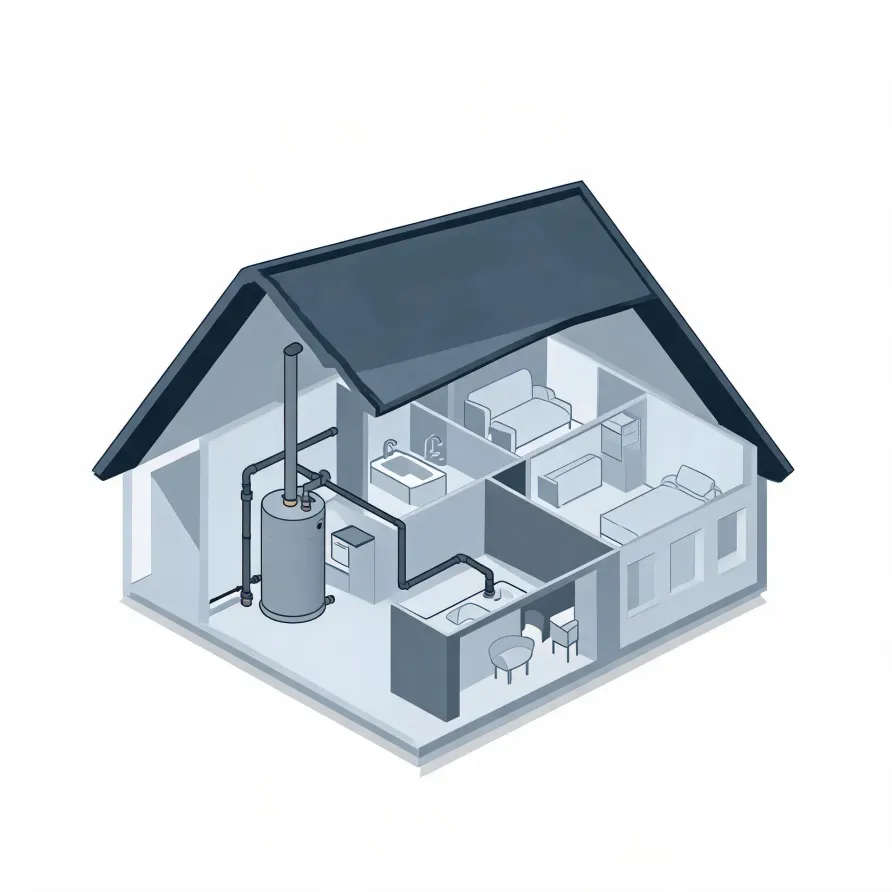
The tank is the center of the system, a large insulated vessel that sits in a utility room, basement, or garage and holds water at a set temperature around the clock. The burner assembly or heating element sits at or near the base of the tank and is what actually raises the temperature. When water stays cold or heats unevenly, these are the pieces a contractor looks at first.
The thermostat controls when heating starts and stops, and it mounts directly on the tank or on the burner assembly. The pressure relief valve and the anode rod sit on or inside the tank itself. The rod slows corrosion from the inside out, and the valve releases pressure if it builds beyond a safe level. A dip tube runs down through the tank and directs cold incoming water to the bottom so hot water stays at the top.
The drawing shows a general layout of these components, and a licensed contractor determines which parts apply and what condition they are in for your specific unit.
Get matched in Grand CountyGrand County by the Numbers
159 severe weather events were recorded in Grand County, Utah between 2015 and 2024.
NOAA National Centers for Environmental Information, Storm Events Database, bulk CSV export, events 2015-01-01 through 2024-12-31.Half the homes in Grand County, Utah were built in 1988 or earlier (2020-2024 ACS 5-year).
U.S. Census Bureau, 2020-2024 American Community Survey 5-Year EstimatesGrand County, Utah holds 5,424 housing units (2020-2024 ACS 5-year).
U.S. Census Bureau, 2020-2024 American Community Survey 5-Year EstimatesOwners occupy 70.3% of the occupied homes in Grand County, Utah (2020-2024 ACS 5-year).
U.S. Census Bureau, 2020-2024 American Community Survey 5-Year EstimatesCodes & Standards for Water Heater Repair in Grand County, Utah2 sourced rules & standards
Licensing and Legal Requirements in Grand County, Utah
Utah’s contractor licence does not reach alteration, repair, remodelling or improvement of a building worth less than $7,000 in labour and materials together, counting every change and addition to the agreed work — though the plumbing and electrical trades are pulled back under licensure even below that figure.
Utah requires a state licence before engaging in a licensed construction trade or contracting activity, and HVAC contractor is one of the licence classifications the state issues.
Severe Weather Events in Grand County
Water heaters work harder when the climate around them swings hard. What happens outside in Grand County drives the stress that accumulates inside the equipment, and that stress is what brings repair calls.
159 severe weather events, 2015–2024. Source: NOAA National Centers for Environmental Information, Storm Events Database.